“All I can tell you for certain is that my entire life has been shaped by an early decision to reject the cult of artistic martyrdom, and instead to place my trust in the crazy notion that my work loves me as much as I love it – that it wants to play with me as much as I want to play with it – and that this source of love and play is boundless” – Elizabeth Gilbert (Author “Eat, Pray, Love”) – from “The Big Magic”, the chapter called ‘Stubborn Gladness’.
Sometimes – no, often – feel-good art is being criticized for being, according to some, without meaning and content. I think it is unfair.
Firstly, I think that If you, as an artist, are academically inclined you may lean more towards art with social/political content or commentary on several issues. You should however keep in mind that a very small percentage of people are educated in History of Art or Art Appreciation. Very many people buy art purely for the visual pleasure that it provides and it should be their right to do so. I think that it is very arrogant of artists to attempt to “own” art. You don’t, and neither do artists that only make art with deep and profound content. It is also very interesting that many artists make art with socio/political commentary, get high praise for it, and then, in between, simply make pretty art – a plate full of pomegranates, a watercolor landscape, and the likes – and never get criticized for that!
Secondly, I think it is about personalities – some personalities function better when a little troubled – there is nothing wrong with being happy in your unhappiness – do not fight your personality, and make deep art with profound content!
Equally, all of the above should provide space for people who simply love their art and the execution thereof. Elizabeth Gilbert, the author of “Eat, Pray, Love”, also wrote the fascinating work on creativity with the title “The Big Magic”. What a wonderfully inspiring read this is! She writes: “I want to make something clear here: I do not deny the reality of suffering – not yours, not mine, not humanity’s in general. It is simply that I refuse to fetishize it. I certainly refuse to deliberately seek out suffering in the name of artistic authenticity. As Wendell Berry warned, ‘to attribute to the Muse a special fondness for pain is to come too close to desiring and cultivating pain’”.
I, therefore, think that it is very unfair to crucify an artist for making art that is not commenting on anything but purely celebrates life’s beauty – in flowers, animal life, landscapes, and portraits. I repeat: no one genre owns art – that is simply arrogant.
I posted the question to my art group/students: Does art have to have meaning and deep content to be good? Can pretty art be good art?
The first response came from Hesti-Mari Kleynhans, published writer and amateur artist: “Just because you have the right to voice your opinion doesn’t mean it is right to voice all opinions.” and “Art should evoke emotion from the onlooker. A painting should evoke an emotional response. If an artist puts his/her feelings and emotions in a painting, the onlooker is bound to feel something. It is about emotion, not content. Sometimes an “ugly” work of art will profoundly move you emotionally, sometimes you will feel absolutely nothing when looking at a perfectly executed, visually beautiful artwork. Every person interprets art differently from the next.”
Rina de Klerk, Art Historian, and excellent botanical artist: “I think that the cliché regarding art that you find strange or difficult to understand, is fittingly explained in the film Mona Lisa Smile: ‘You are not required to like it, you are required to consider it.’ Having said that, the reason why I like certain artworks, is simply that I like them!”
Braam Naudé, brilliant professional artist: “I am unsure at what stages art was socio-political and when decorative art emerged. There is space for both. Political works are important for public spaces. Brett Murray and James Gubb both did art that was equally pretty and full of content. Only when you study these works will you understand the hidden message. Then there is “beautiful” art that simply celebrates life, capturing a moment, a color, or a feeling. This discussion can go on for hours. Can I be so bold as to say that beautiful art comes from the heart and most political art derives from the intellect? Ps, some “deep” art is butt ugly!”
Sonja Mitton-Barnard, successful professional artist, member of Two Tall Artists: “if only art with profound content is good art, then I am not a good artist. I need visually pleasing things in my life. It makes me happy. I feel lighter. Visually pretty art can evoke deep emotion if it is linked to a memory or person that you hold in great esteem. My art reminds me of good times and dear people.”
Rusha du Toit, artist: “Art must have an emotional reaction. It does not have to be necessarily good or pleasant. Even if it only lets you contemplate the reason for your reaction, it has done its job.”
My opinion on this is that some opinions have been voiced (painted) so often that there is nothing new to say. I am not going to get into trouble by publishing some of these, but we all know them – variations on the same theme, ad nausea. At first, it touched my soul, now my only reaction is that of boredom – I have seen this so often before.
Years ago, a wise lecturer was adamant about the fact that often the content of a work of art simply is to be found in the technique thereof.
The history of art shows so many genres and variations thereof: the earliest known examples of art are mostly spiritual or mystical. Early Christian art was narrative as well as decorative. The Romans painted portraits and images of their villas and landscapes on their walls – may be a bit show-off but purely decorative. Examples of commentary in the art are abundant, through the history of man and art, and so is art purely for sensory enjoyment.
IS THIS PRETTY? IS IT FULL OF CONTENT? DOES IT EVOKE EMOTION?


Work By: Braam Naudé
From everything said here, it should be abundantly clear that firstly, nobody spiritually owns art except your own; and secondly that there is a place and a time for everything from profoundly beautiful to profoundly ugly and everything in between.
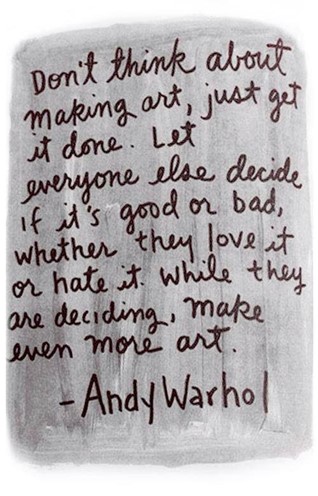
The most important thing is: MAKE ART!
